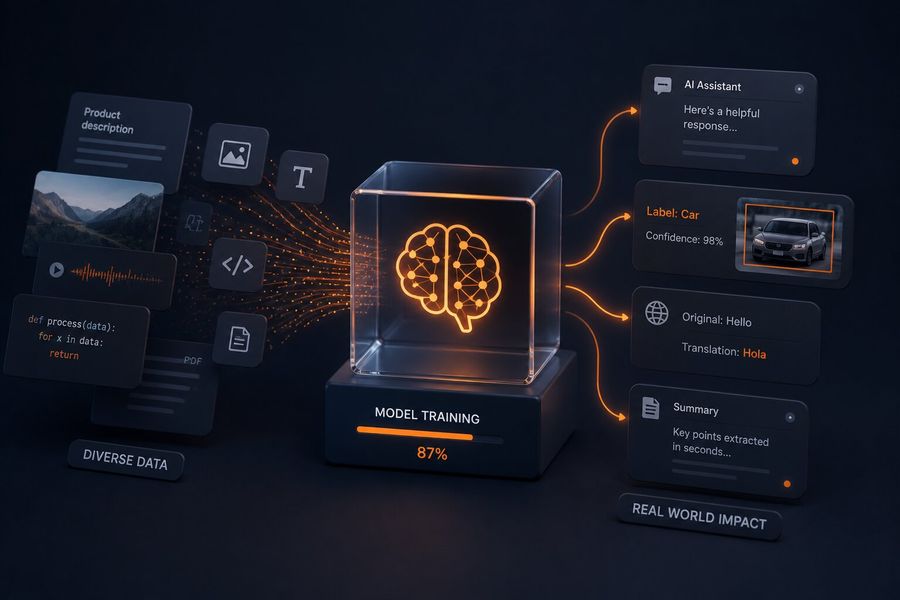
If you've ever wondered what it actually means to "train an AI", you're not alone. The phrase gets thrown around constantly, but the mechanics behind it are rarely explained clearly. Here's a plain-English breakdown, and exactly where human contributors like you fit in.
What is AI model training?
At its core, training a large language model (LLM) means showing it enormous quantities of data, text, code, conversations, and adjusting its internal parameters until it can predict outputs that are useful, accurate, and safe. But raw data alone isn't enough. The model also needs human feedback to learn what "good" looks like.
RLHF, the role of human judgment
Reinforcement Learning from Human Feedback (RLHF) is the technique most frontier AI labs use to align model behaviour with human values. Here's how it works in practice:
- The model generates several candidate responses to a prompt.
- A human contributor reviews the responses and ranks them, or rates them against specific criteria.
- Those rankings are used to train a "reward model" that learns to predict what humans prefer.
- The main model is then fine-tuned against that reward signal.
This loop repeats thousands of times, across millions of examples. Your judgments, collectively, shape how the model behaves.
Data annotation, the foundation
Before RLHF even begins, AI models need labelled data. That means humans reviewing text, images, or audio and applying structured labels, identifying entities, classifying intent, tagging sentiment, or transcribing content. It's careful, detail-oriented work, and it forms the bedrock of every modern AI system.
AI evaluation, the quality gate
Once a model is trained, it needs to be evaluated before deployment. Evaluators assess outputs for accuracy, safety, clarity, and factual correctness. In domain-specific applications, medical, legal, financial, this requires genuine expertise. A model trained on medical data needs a clinician to tell it when it's wrong.
Why humans can't be replaced
AI systems cannot reliably evaluate their own outputs. They lack the real-world grounding, ethical intuition, and domain knowledge that human reviewers bring. This is why the demand for skilled human contributors has grown alongside AI capability, not shrunk.
Getting started
The entry point varies by role. Some annotation tasks require no prior AI experience, strong attention to detail and clear communication are enough. Evaluation and RLHF roles often require domain expertise or technical background. The common thread is that your human judgment is the product.