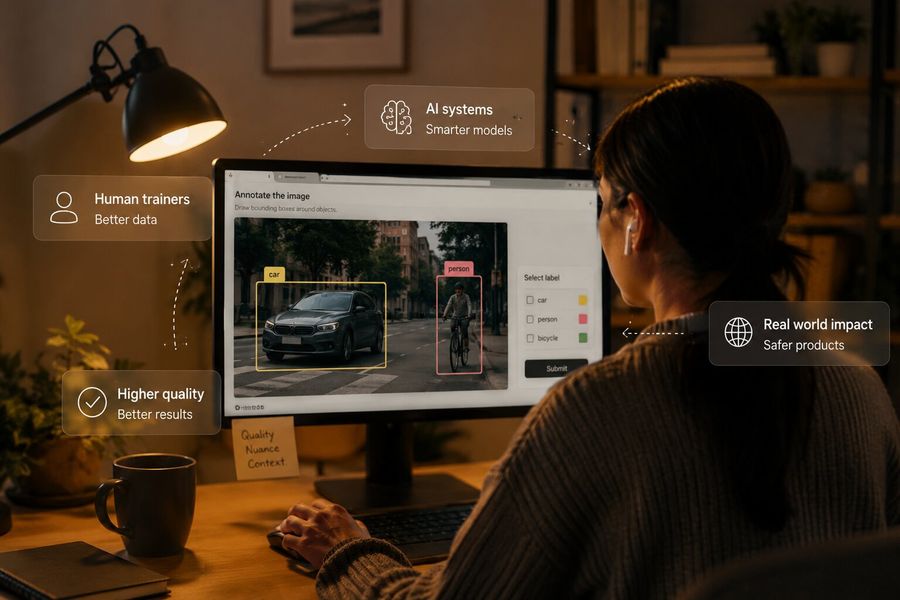
The headlines are all about AI replacing jobs. But quietly, and on a massive scale, AI is creating them. Thousands of people around the world are now earning real income reviewing model outputs, labelling data, evaluating AI responses, and helping shape the behaviour of systems used by hundreds of millions of people. Most of them never saw a job listing for it. They found it through a network. They got in through a connection.
That's the gap Crossing Hurdles was built to close.
Why AI companies need you, right now
Every large language model you've ever used, GPT, Gemini, Claude, Llama, was shaped by thousands of hours of human feedback. Not just in its initial training, but continuously: as it gets updated, fine-tuned, red-teamed, and evaluated for new use cases. The need for human input doesn't shrink as models get smarter. If anything, it grows, because smarter models need more sophisticated evaluation.
AI labs, data platforms, and enterprise AI teams are all competing for the same scarce resource: reliable human judgment. And there is far more demand than there are qualified contributors filling it.
What these jobs actually look like
The term "AI training job" covers a wide spectrum of work. Some of it is straightforward, answering questions to help a model learn natural conversation. Some of it is highly specialised, a cardiologist reviewing whether an AI's ECG interpretation is clinically sound. The common thread is human judgment: evaluating, labelling, ranking, and refining AI outputs in ways the systems cannot reliably do themselves.
The main categories of work include:
- Data annotation, tagging text, images, audio or video with structured labels. High volume, accessible to careful non-technical contributors.
- RLHF (Reinforcement Learning from Human Feedback), rating or ranking model responses to train reward models that guide future behaviour.
- AI evaluation, systematically testing model outputs for accuracy, safety, bias, and domain correctness.
- Red-teaming, adversarial testing: trying to make models behave badly, to find vulnerabilities before deployment.
- Instruction following audits, verifying that a model does exactly what it was asked to do, across varied and complex prompts.
What unites all of these is that they are skilled work. Not in the software engineering sense, but in the human sense. They require attention, care, domain knowledge, and the kind of nuanced judgment that machines have not yet replicated.
Why this boom has been so quiet
If there's so much demand, why don't more people know about it? Several reasons.
First, much of this work has historically flowed through closed contractor networks. AI labs build relationships with trusted data vendors. Those vendors draw on curated contributor pools. The whole chain runs on referrals and vetting, not public job boards.
Second, the work is often indirect. You might contribute through a research platform, a specialist data company, or an enterprise's internal AI team, without ever interacting directly with the underlying model provider. The supply chain is long and opaque.
Third, there's a persistent misconception that these are low-skill, low-pay "click farm" jobs from a decade ago. That was sometimes true of early crowdsourced annotation. It is not true of what frontier AI labs actually need today. The work has evolved. The pay has followed.
Who's doing this work, and who could be
Look at the current contributor base for major AI training programmes and you'll find a striking range of backgrounds. Software developers. Linguists. Teachers. Nurses. Lawyers. Translators. Philosophers. The common factor isn't a specific credential, it's a combination of clear thinking, domain knowledge, and the ability to evaluate information critically and consistently.
Some of the most sought-after profiles right now include:
- Medical professionals (physicians, nurses, pharmacists) for healthcare AI evaluation
- Legal professionals for contract review, case analysis, and legal reasoning tasks
- Native speakers of lower-resource languages (Arabic, Hindi, Swahili, Bengali, and dozens more)
- Domain experts in finance, education, engineering, and science
- Strong generalist writers and editors for content quality work
- Developers and data scientists for code evaluation and technical benchmarking
If you are reading this, there is a reasonable chance you already have what the industry needs. The obstacle is rarely qualification. It's visibility.
What "free for candidates" actually means
The Crossing Hurdles model is structured around a simple principle: contributors should never pay to access work. The companies paying for AI training are the clients. You are the product, in the best possible sense.
Every opportunity in our network is vetted. Every company is verified. Joining is free, and always will be. Our business model is built entirely on the company side, we earn by connecting qualified contributors to projects, not by charging contributors to participate.
This matters because the AI training space, like any fast-growing industry, has attracted bad actors. Platforms that charge contributors "registration fees." Projects that solicit work and don't pay. It's a real risk, and one we take seriously. Our vetting process exists to protect the people who join our network.
Getting started today
The boom is not slowing down. As AI capabilities expand, the need for human oversight, evaluation, and training data grows with it. The next two to three years represent a significant window, a period when human expertise is both critically needed and well-compensated, before automation starts to close the gap in some of the more routine tasks.
The contributors who will benefit most are those who get in now, build a track record, and develop the skills that move them up the value chain, from basic annotation toward evaluation, red-teaming, and specialist domain work.